Archive for the 'patterns & tutorials' Category

sideways

sideways

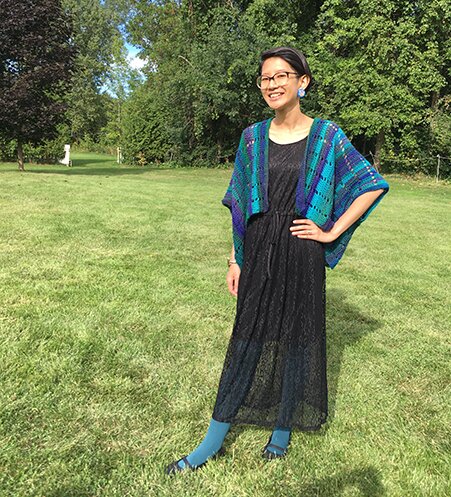
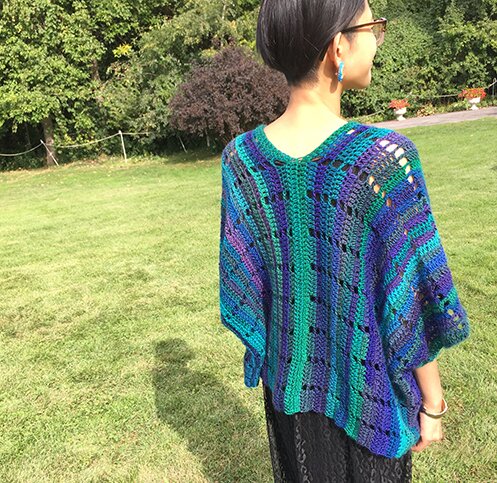
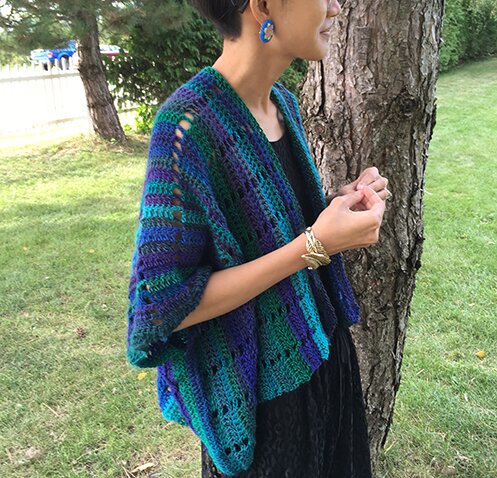
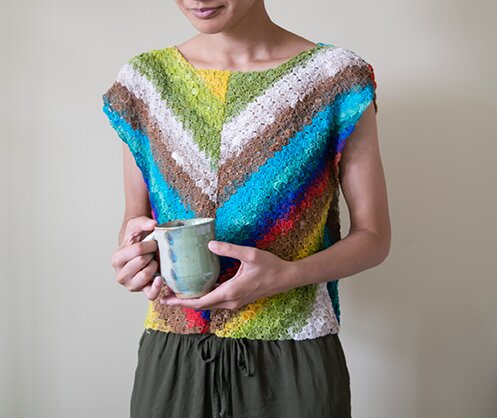
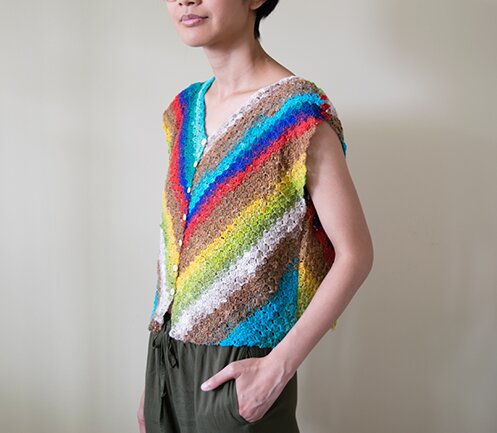
Sideways is a pullover that is worked in one piece in a sideways manner, from one sleeve cuff to the other, forming a herringbone-like pattern. Then it is folded in half along the shoulders, with the side underarm seams sewn together. 


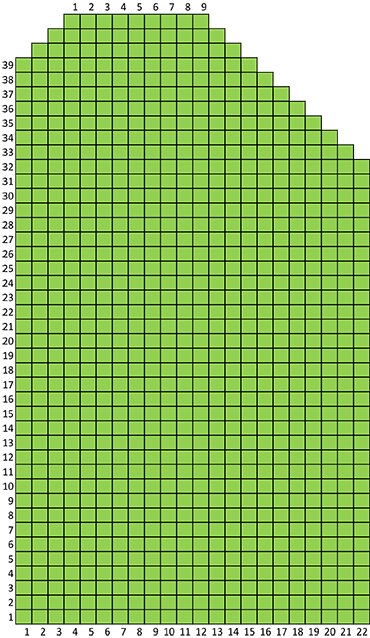
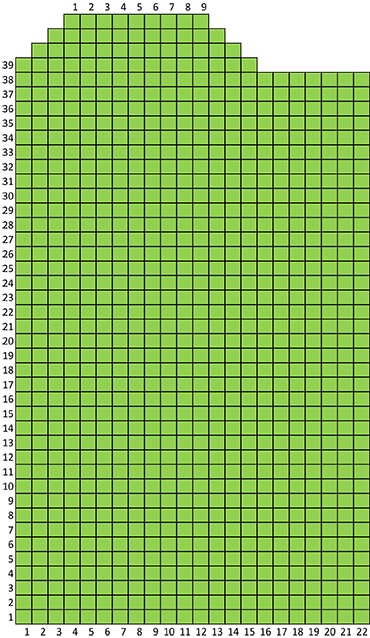
sideways diagram


I bought a giant ball of cheap and cheerful Red Heart acrylic to experiment while making up this pattern. Turned out a little stiff but I don’t mind it. But I would imagine it would look rather nice with a yarn that has a nicer drape, like Caron Simply Soft or Bernat Satin.

Yarn: worsted weight, approx. 700 yd 

Hook: 6.5mm, 5.5mm

Measurements:
Bust: 38″
Length: 18″ 
Sleeve length (underarm to sleeve cuff): 13″
Neck opening: 15″

My pattern writing ability is limited so I don’t want to attempt making different sizes. But here are some simple ways that I can think of for alteration:

To make smaller sizes I would suggest using a DK or sport weight yarn with a 4.5 mm hook and using the pattern as is.

To make larger sizes I would suggest increasing the number of foundation chains by multiples of 4, and then adding more rows in between increases and decreases in the sleeves, and adding more “work in pattern” rows in the middle of front and back.

More notes…

This pattern hasn’t been tested, and it’s written from a crude diagram that I drew while crocheting. I tried to elaborate as much as possible when writing it out, and it’s a very simple pattern repeat, but some experience in crocheting is required to understand the abbreviated parts of the pattern (i.e. where it says “work in pattern”). The basic pattern repeat is rows 2-3. It would be pretty obvious what you need to do once you get the hang of the pattern repeat, but probably not a beginner’s project.

In the pattern wherever it says dc into a ch 2 or ch 1 space I actually crochet into the chain to make the fabric less bulky/stiff given the yarn I was using, but you can just crochet into the ch 2 or ch 1 space too, if you prefer.

Ok… on to the pattern.


Pattern

Sleeve, with larger hook

Row 1: ch 36, dc in 4th ch from hook, dc in next ch, ch 2, sk 2 ch, *dc in next two ch, ch 2, sk 2 ch*, rep from * to *, end with dc in last two ch, turn.

Row 2: ch 4, 2 dc in next ch 2 sp, *ch 2, 2 dc in next ch 2 sp*, rep from * to *, end with ch 1, dc in top of last dc, turn.

Row 3: ch 3, dc in next ch 1 sp, ch 2, *2 dc in next ch 2 sp, ch 2*, rep from * to *, end with dc in last ch 1 sp, dc in top of last dc, turn.

Row 4 (increase row): ch 3, dc in same st, ch 2, *2 dc in next ch 2 sp, ch 2*, rep from * to *, end with 2 dc in top of last dc, turn.

Rows 5-16: repeat rows 2-4 four times

Row 17: repeat row 2

Body

Row 18: repeat row 3, don’t turn at the end of the row, ch 44, remove hook from look, don’t fasten off. Attach a separate ball of yarn at top of ch in the beginning of row, ch 41, fasten off.

Row 19: place hook back in the loop at the end of row 18, turn. ch 3, dc in next ch, ch 2, sk next 2 ch, *dc in next two ch, ch 2, sk next 2 ch*, rep from * to *, end with 2 dc in final two ch, turn.

Row 20: ch 4, 2 dc in next ch 2 sp, *ch 2, 2 dc in next ch 2 sp*, rep from * to *, end with ch 1, dc in top of last dc, turn.

Row 21: ch 3, dc in next ch 1 sp, ch 2, *2 dc in next ch 2 sp, ch 2*, rep from * to *, end with dc in last ch 1 sp, dc in top of last dc, turn.

Row 22-25: repeat rows 20-21 twice.

Front

Row 26 (decrease, neck shaping): mark the midpoint across body, which is the 18th set of 2-dc. Repeat row 20, end with 2 dc in the ch 2 sp before midpoint, dc in next dc, turn.

Row 27 (decrease, neck shaping): ch 3, 2 dc in next ch 2 sp, work in pattern to end, turn.

Row 28 (decrease, neck shaping): work in pattern until last ch 2 sp, 2 dc in last ch 2 sp, dc in top of turning ch, turn.

Row 29: ch 4, 2 dc in next ch 2 sp, work in pattern to end, turn.

Row 30: work in pattern until turning ch from last row, dc in 4th ch of turning ch, dc in 3rd st of turning ch, turn.

Row 31-33: work in pattern.

Row 34 (increase, neck shaping): work in pattern until last two st, dc in last two st, dc again in last st, turn.

Row 35 (increase, neck shaping): ch 3, dc in next dc, ch 2, 2 dc in next ch 2 sp, work in pattern to end, turn.

Row 36 (increase, neck shaping): work in pattern until last ch 2 sp, 2 dc in last ch 2 sp, ch 2, 2 dc in top of turning ch, fasten off.

Back

Row 26 (decrease, neck shaping): attach yarn at midpoint. ch 3, 2 dc in next ch 2 sp, work in pattern to end, turn.

Row 27 (decrease, neck shaping): work in pattern until the last ch 2 sp, dc in last ch 2 sp, 2 dc-tog in ch 2 sp and turning ch, turn.

Row 28 (decrease, neck shaping): ch 3, 2 dc in next ch 2 sp, work in pattern to end, turn.

Row 29: work in pattern until last ch 2 sp, 2 dc in last ch 2 sp, ch 1, dc in turning ch, turn.

Rows 30: ch 3, dc in ch 1 sp, ch 2, work in pattern to end, turn.

Rows 31-33: work in pattern.

Row 34 (increase, neck shaping): ch 4, dc in first dc, dc in next ch 1 sp, ch 2, 2 dc in next ch 2 sp, work in pattern to end, turn.

Row 35 (increase, neck shaping): work in pattern until last ch 2 sp, 2 dc in last ch 2 sp, ch 2, dc in 4th ch of turning ch, dc in 3rd ch of turning ch, turn.  

Row 36 (increase, neck shaping): ch 4, dc in first dc, dc in next ch 1 sp, ch 2, 2 dc in next ch 2 sp, work in pattern to end, turn.

Body, joining front and back

Row 37: work in pattern until last ch 2 sp of BACK, 2 dc in ch 2 sp, ch 2, [dc in top of turning ch of BACK, dc in the first dc of FRONT], ch 2, 2 dc in next ch 2 sp, work in pattern to end, turn.

*Tie the bases of the two stitches in square brackets together with a short length of yarn*

Rows 38-44: work in pattern. There should be 35 pairs of 2-dc across the front and back of body on the rows that begin and end with a pair of 2-dc. Fasten off at the end of row 44. Turn.

Sleeve

Row 45: Join yarn in ch 2 sp after the 21st pair of 2 dc, ch 3, dc in same ch 2 sp, *ch 2, dc in next ch 2 sp* 13 times. Turn.

Row 46: work in pattern.

Row 47: ch 2, dc in first ch 1 sp, ch 1, 2 dc in next ch 2 sp, work in pattern till last ch 2 sp, 2 dc in last ch 2 sp, ch 1, 2 dc tog in 4th ch and 3rd ch of turning ch. Turn.

Row 48: ch 3, dc in next ch 1 sp, 2 ch, 2 dc in next ch 2 sp, work in pattern till last ch 1 sp, dc in ch 1 sp, dc in top of turning ch. Turn.

Rows 49-61: repeat rows 46-48 four times.

Rows 62-63: work in pattern. Fasten off at the end of row 63.

The entire sweater is now finished! We’re almost there :D

Finishing

Fold sweater in half along shoulder line with right sides facing together (which ever side looks better to you can be the “right side”), sew side and underarm seams together. Turn right side out.

Using the smaller hook, crochet a round of hdc evenly around each sleeve cuff and neck opening, and a round of tr around bottom edge of sweater. (2 st in each end of row seems to work out pretty evenly for me.) 

Weave in ends, put on sweater and be cozy :D


sideways 2

Please don’t hesitate to drop me a note if there’s anything unclear or if you spot any mistakes in the pattern.

Have a wonderful week, everyone!


sakura

DSC02353

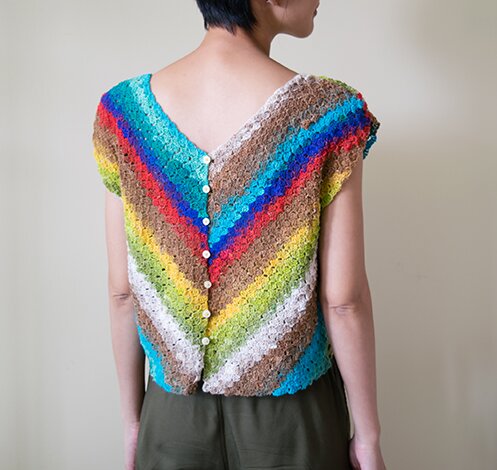
Looking forward to spring and cherry blossoms! A cozy circle scarf pattern for Lunar new year! :D You know, in Chinese Lunar New Year is also called 春節, which literally translates into “spring festival” in English.

I’ve been seeing this combination of stitches (single crochet, chain one) in different projects around the web, have also used it in my bucket hat pattern for a basket weave kind of texture. Recently I was making a circle scarf for a friend and figured that when arranging rows of colours in certain ways it actually looks kind of like plaid. 

DSC02365


It’s made with a larger hook so it’s quite soft. 

I used:

Three skeins of worsted weight yarn in grey, pink and white, approx. 100g per skein (only used half a skein for each colour)

9mm hook 

5mm hook (to weave in ends)

Two hours – a very quick project

Circle scarf:

With grey and larger hook, ch 130 (you can ch more or less to adjust the length. Mine wraps around my neck twice snugly. Just make sure that there is an even number of stitches).

Being careful not to twist, sl st in first ch to form a circle.

Row 1: ch 2 (counts as sc, ch 1), *skip next ch, sc in next ch, ch 1* repeat from * to * to end, sl st in first ch of row while changing colour to pink. Here’s how I usually change colours at the end of row. When doing the yarn-over to make the sl st at the end of row, yarn-over the new colour (in this case, pink) instead of the working yarn (in this case, grey), like so…

DSC02342

Tie the short end of pink to the working yarn (grey) to secure it. 

Row 2: with pink, TURN (be sure to turn the work at the beginning of each row, otherwise the pattern will look slanted). sc in first ch 1 sp, ch 1, *sc in next ch 1 sp, ch 1* repeat from * to * to end, sl st in first sc of row while changing yarn to white.

Row 3: with white, TURN, carry up the other two colours of yarn and wrap them in the first sc in first ch 1 sp, repeat row 2.

With subsequent colour change, yarn-over with the new colour as you make the sl st at the end of the row, TURN, then carry up the other two colours and wrap them in the first stitch you make with the new colour in the start of the row. Let go of the other two colours as you go around the scarf.

Repeat Row 3 with the following colour sequence:

Pink

Grey

Pink

White

Pink

Grey

Pink 

White

Pink 

Grey

Pink

White

Pink

Grey

Grey

With smaller hook, weave in ends.

DSC02361

Keep warm until spring arrives! 


sherbert, the yeti


Meet Sherbert, the yeti :D

Sherbert lives on our couch with Filbert the Chococat and Herbert the tiny elephant (Mike found him wandering about at a trade show and invited him home).

Anyhoo, here’s how I made Sherbert the yeti. He’s actually made based on the groundhog pattern, just with a more elongated body and legs, and different arms. And because of the kind of yarn and size of hook used, he turned out quite a bit bigger than groundhog (Sherbert is 4″ tall, while groundhog is 3″), but still tiny, for a yeti.


I used:

A fuzzy kind of yarn in white, like this one.

Worsted weight yarn in light blue

5.5mm and 3mm hook

Sewing needle and white thread

Tapestry needle

Small piece of  felt in light blue

Embroidery thread in brown, pink, and white

Stuffing (I used yarn scraps)


Head and Body:

With white yarn and 5.5mm hook:

Row 1: ch 3, 5 sc in 3rd ch from hook, sl st. in top of beginning 2 ch.

Row 2: ch 2, [2sc in next sc, sc in next sc] 3 times, sc in top of beginning ch.

Row 3 and on: sc around until piece measures 1.5 inches from the beginning,  take hook off loop, don’t fasten off.

Cut an oval out of the light blue felt about 1″ wide and 3/4″ tall. Embroider eyes, mouth, teeth, and other facial features as desired. Sew face to head (the piece you just crocheted) with sewing needle and thread.

Put hook back in loop where you left off. Continue with sc in each sc until piece measures 2.5″ from the beginning. End with last st in centre front (I just eyeballed it, but one could count the stitches to make sure it’s centered if desired), don’t fasten off, continue onto legs.

Legs:

ch 2, bring the ch across the opening of the body and sc in a st in centre back (I just eyeballed it, but one could count the stitches to make sure it’s centered if desired – the groundhog pattern has process photos that explains this step). 

Then, sc in each sc until the ch 2 in the middle, sc in each ch, then sc in each sc for 3 more rounds, sl st. in each of next 2 sc, fasten off.

For the other leg, attach yarn to the same st in centre front at the base of the other leg, ch 1, sc in next sc, sc in each sc until the st in centre back at the base of the other leg, sc in the st in centre back, sc in each ch of the ch 2 in the middle (one would have to crochet in the back loops of the chain), sc in the beginning ch 1 of this leg, sc in each sc for 2 more rounds, sl st in each of next 2 sc, fasten off.

Now would be a good time to stuff the groundhog through the openings at the bottom of the legs. After stuffing, close the bottom of the legs by weaving through the inner loops of the opening with yarn and tapestry needle. Weave in ends.

Arms (make 2):

ch 5, sl st in 2nd ch from hook, sl st in each of next 2 ch, ch 1, fasten off.

This makes a thick chain with kind of a forked end, like this…

Weave ends into the thick chain.

Hands (make 2):

With light blue yarn and 3mm hook:

ch 4, sl st in 2nd ch from hook, sl st in each of next 2 ch, *ch 2, sl st in 2nd ch from hook, sl st in very first ch*, repeat from * to * once more, ch 4, sl st in 2nd ch from hook, sl st in each of next 2 ch, sl st in very first ch, fasten off. 

The hand looks like this…

Assembly:

Sandwich the top half of the hand between the forked ends of the arm, hiding the yarn ends of the hand. Sew in place with sewing needle and white thread (the fuzzy yarn is really good with hiding sewing stitches).

Repeat for the other arm and hand.

With sewing needle and white thread, sew arms to body.

The arm and hand look like this…


And yeti is ready to take on the world! :D


Even challenging the difficult and dangerous mount of yarn, facing the great risk of a yarn avalanche!


But at the end of an adventurous day, Sherbert the yeti is back on the couch, enjoying a cup of cocoa with his friends, and wishing everyone an awesome week filled with wonderful, exciting things.


P.s. if you spot errors or anything unclear about the pattern feel free to drop me a note! 


fun foam stamping

It was one of those experiments that went very smoothly and turned out amazingly well, which doesn’t happen too often for me but when it does, it’s super exciting!

Printing fabric with stamp made from craft foam (or, as advertised on the package, “fun foam”)!

It’s REALLY easy. Everything about this project is encapsulated in this photo.


I used:

Craft foam (it looks like this) that I bought from the dollar store (12 sheets for $1)

A piece of foam core that I found at work (it had an event poster mounted on it and they were throwing it out. But I’ve also seen foam core at the dollar store)

Acrylic paint and paint brush (from the dollar store, of course)

Glue stick (I found this amazing Elmer glue at the dollar store! A bit of a theme going on here…)

A piece of fabric that was the remnant of a curtain that I was sewing for a friend. It feels like linen. Fabric with smooth texture works best.

What I did:

1. Cut design out of craft foam. Exacto knife works extremely well with this stuff.

2. With Exacto knife, Cut out a piece of foam core the same shape as the craft foam design but about 1/4″ larger all around.

3. With glue stick, apply a liberal amount of glue on the foam core. Press craft foam design firmly onto where the glue is applied. Stamp is made! :D

Here’s a closeup of my leaf stamp, after it’s made a few prints…

4. Set stamp aside for a minute or two for the glue to dry. In the meanwhile, mix a fun colour with acrylic paint, set out some scrap paper (paint will seep through fabric onto your work surface), and lay fabric on it.

5. Apply a thin layer of paint onto foam stamp with paint brush (not too much paint, but the stamp has to be wet). Test print on scrap paper.

6. Stamp away! The great thing about applying paint with a brush is that you can have streaks of different colours in one print! :D

7. If the finer details of the stamp starts to get gunked up with paint, use the corner of the brush bristles to clean it out before making the next print.

8. Set fabric aside for a couple of hours to dry. Place a towel on it, then iron at low heat to fix the colour.


And now we have a lovely piece of printed fabric to do whatever our hearts desire :D I sewed mine into a simple drawstring bag. (there are lots of nice drawstring bag tutorials out there, like these ones, so I won’t repeat what I did here)


Placemats, shirts, skirts, eyeglasses case… the possibilities are endless! 

Have a great start to the week, everyone!


pastel


A dress pattern! :D

A variation of ginkgo the square top. Inspired by a dress I saw at American Apparel, which was half lace and half satin kind of material. And I thought (as I usually do when I see anything I like at the stores), “I could make that.”

I’m not a fun person to go shopping with, that’s for sure. Anyway. On to the pattern!

Here’s the back of it, and a closer look at the crochet pattern.


Below is the written pattern for crocheting the top part of the dress. I will then explain how to make and attach the skirt part of the dress. Please forgive my lack of photos in that part (>_<)… I tried to draw diagrams to explain some of the steps, hope they help!

Finished size: bust 32″, waist 26″, length 16″, with a bit of negative ease.
To create larger sizes, I’d suggest using a heavier cotton and a larger hook, i.e. DK/sport (3.5mm hook); worsted (5mm hook).

For the top, I used:
#10 cotton thread
2.5mm hook

For the skirt, I used:
1/2 yard sheer fabric
1/2 yard white polyester satin
(the amount of fabric required may vary; it depends on the size of the top and how full you want your skirt to be. See the Skirt section below)


Top (make 2) 

Stitch pattern:
Fan = [dc, 2ch, dc, 2ch, dc] in same space

ch 96

Row 1: ch 3, dc in 4th ch from hook, dc across, turn.

Row 2 (set up row): ch 5, dc in 1st dc, skip next 2 dc, dc in next dc, [skip next 2 dc, fan in next dc, skip next 2 dc, dc in next dc] to end, [dc, ch 2, dc] in turning ch, turn.

Row 3 (pattern row 1): ch 3, skip first dc, fan in dc between fans, [dc in 2nd dc of next fan, fan in next dc between fans] to end, dc in 3rd ch of turning ch, turn.

Row 4 (pattern row 2): ch 5, ch in 1st dc, dc in 2nd dc of next fan, [fan in next dc between fans, dc in 2nd dc of next fan] to end, [dc, ch 2, dc] in turning ch, turn.

Rows 5-6: work pattern rows 1 & 2 once more.

Row 7: work pattern row 1.

Row 8 (increase row): ch 3, dc in 1st dc, ch 1, dc in same dc, dc in 2nd dc of next fan, work in pattern until turning ch, [dc, ch 1, 2 dc] in turning ch, turn.

Row 9 (increase row): ch 4, dc in next dc, skip next dc, fan in next dc, work in pattern to last dc between fans, fan in last dc between fans, dc in 2nd last dc before turning ch, ch 1, dc in turning ch, turn.

Row 10: ch 3, fan in next dc, dc in 2nd dc of next fan, work in pattern to 2nd last dc of row, fan in 2nd last dc of row, dc in 3rd ch of turning ch, turn.

Rows 11-16: work pattern rows 2, 1, 2, 1, 2, and 1.

Rows 17-19: repeat rows 8-10.

Rows 20-30: work in pattern. End with row 2.

Armhole shaping:

Row 31: ch 1, sl st in 1st dc, next ch 2 space, next 3 dc, next ch 2 sp, and next dc. ch 3, fan in next dc between fans, work in pattern until last fan, dc in 2nd dc of 2nd last fan, leave remaining st unworked, turned.

Row 32: ch 3, dc in 2nd dc of 1st fan, work in pattern until last fan, dc in 2nd dc of last fan, dc in turning ch, turn.

Row 33: ch 5, dc in 1st dc, dc in 2nd dc of 1st fan, work in pattern until last fan, dc in 2nd dc of last fan, [dc, ch 2, dc] in turning ch, turn.

Row 34-36: work pattern rows 1, 2, and 1.

Neckline shaping – right:

Row 37: work in pattern to the 5th fan of the row, dc in 2nd dc of the 5th fan, dc in next dc between fans, turn.

Row 38: ch 3, dc in 2nd dc of 1st fan, work in pattern to end.

Row 39: work in pattern until last fan, dc in 2nd dc of last fan, dc in turning ch, turn.

Row 40: ch 5, dc in 1st dc, dc in 2nd dc of 1st fan, work in pattern to end.

Row 41 – 51: work in pattern.

Row 52: ch 1, sc in 1st dc, [sc in 2 ch sp, sc in next dc, sc in 2 ch sp, sc in dc between fans] until last dc, skip last dc, sc in turning ch, sc in 3rd ch of turning ch. Fasten off.

Neckline shaping – left:

Row 37: counting from the left edge, attach yarn to the dc between the 5th and 6th fans. 

Row 38: work in pattern until last fan, dc in 2nd dc of last fan, dc in turning ch, turn.

Row 39: ch 3, dc in 2nd dc of 1st fan, work in pattern to end, turn.

Row 40: work in pattern until last fan, dc in 2nd dc of last fan, [dc, ch 2, dc] in turning ch, turn.

Rows 41-51: work in pattern.

Row 52: ch 1, sc in 1st dc, sc in ch 2 sp, [sc in dc between fans, sc in ch 2 sp, sc in dc, sc in ch 2 sp] until turning ch, sc in turning ch. Fasten off.


Assembly

With right sides together, sew shoulder and side seams together.

Turn top right side out. Work a round of sc evenly along neckline and armholes. Generally, sc in each dc, and sc in each ch 2 sp; when crocheting into the ends of the row, 2 sc in each row.

Work 1 dc in each dc around the bottom edge of the top.


Skirt – fabric measurement

Cut two rectangular pieces of fabric, one piece for the top layer of skirt, one piece for the skirt lining.

Width for both pieces = 1.5 times the circumference of the crocheted top’s bottom edge.

Measure length of the fabric as desired for the top layer of skirt. Minus 1″ from the length for the skirt lining.

*Add 1/2″ seam allowance to all sides of both pieces of fabric.

Skirt – sewing

For the top layer of skirt, with wrong side facing, fold fabric in half width-wise, so that the short sides are together. Sew the short edges together, so it forms a tube.

Repeat for the skirt lining. Now we have two fabric tubes.

With the wrong side facing on both fabric tubes, place the top layer of skirt inside the skirt lining. Matching top edge and using large stitches, hand or machine sew the top edges together. Don’t back stitch. As shown in the diagram below: the skirt lining is the shorter tube on the outside, the top layer of skirt is inside out inside the skirt lining, and the orange lines are stitches.

Gather the skirt evenly along the seam just sewed by lining it up with the crocheted top, as follows:

With right sides together, line up the top edge of the skirt with the bottom of the crocheted top (the crocheted top will be upside down inside the skirt tubes). Once the skirt is gathered enough so that the top edge of the skirt matches the bottom edge of the crocheted top, pin top to skirt along the the first dc row of the crochet top. Machine sew along the top of the first dc row. The diagram below shows the position of the top inside the skirt tubes in dotted lines, and the orange seam line.


Finally, hem skirt and skirt lining.

And we’re done! :D


Feel free to drop me a note if you have questions or need clarification!

Have an awesome day!


ginkgo


Errata in row 1 – sorry about that! 

 New pattern! :D 

Really liking those half-lace blouses that are popular nowadays. So I figure I could make my own lace :D

It’s basically a part crochet, part fabric square top (my favourite kind of shirts!) with neck shaping.

I tried to make a ginkgo leaf pattern in the lace.


The size I made is 34″ around. But it’s a simple grid-like pattern repeat so every part is easily adjustable. 

I used one skein of #10 cotton crochet thread, and a 2.5mm hook.

Lace pattern starts from the bottom.


Shell = 5 dc in 1 st

Shell in the beginning/end of row = 3 dc in 1 st


Lace (make 2)

ch 135. (for size adjustments, add or minus multiples of 6 stitches. 6 stitches equals approx. 0.75″)

Row 1 (WS): ch 3, dc in 4th ch from hook, dc in each ch across. 

Row 2 (RS): ch 3, 2 dc in same st, skip 2 dc, dc in next dc, [skip 2 dc, 5 dc in next dc, skip 2 dc, dc in next dc] across, skip 2 dc, 3 dc in the top of turning ch. Turn.

Row 3: ch 5, skip shell in the beginning of row, dc in next dc, [ch 2, dc in 3rd dc of shell, ch 2, skip rest of shell, dc in next dc] across, ch 2, dc in top of turning ch. Turn.

Row 4: ch 3, 5 dc in next dc, [dc in dc, 5 dc in next dc across], dc in 3rd ch of turning ch. Turn.

Row 5: ch 5, dc in 3rd dc of shell, [skip rest of shell, ch 2, dc in next dc, ch 2, dc in 3rd dc of shell] across, ch 2, dc in top of turning ch. Turn.

Row 6: ch 3, 2 dc in same st, dc in next dc, [5 dc in next dc, dc in next dc] across, 3 dc in 3rd st of turning ch.

Row 7 – 16: crochet rows 3-6 twice, then rows 3-4

Right neck shaping:

Row 17: work as row 5 until 15 dc’s are made, dc in 3rd dc of next shell, turn.

Row 18: ch 3, skip 1st dc, dc in next dc, [shell in next dc, dc in next dc] to end, 3 dc in turning ch, turn.

Row 19: ch 5, work as row 3, dc in 3rd dc of last shell, skip rest of shell, dc in next dc, turn.

Row 20: ch 3, skip 1st dc, shell in next dc, work as row 4 to end.

Row 21: ch 5, work as row 5, dc in 3rd dc of last shell, dc in turning ch.

Row 22: repeat row 18.

Row 23: ch 1, sc in same st, sc in each st across. Fasten off.

Left neck shaping:

With wrong side facing, counting from the left edge, attach yarn to 3rd dc of the 8th shell.

Row 17: ch 3, skip remaining dc of shell, dc in next dc, work in pattern to end, turn.

Row 18: work in pattern until second last dc, dc in 2nd last dc, dc in last dc, turn.

Row 19: skip 1st dc, dc in 3rd dc of 1st shell, continue in pattern to end, turn.

Row 20: work in pattern, end with dc in turning ch, turn.

Row 21: ch 3, dc in 3rd dc of 1st shell, continue in pattern to end, turn.

Row 22: work in pattern, end with dc in turning ch, turn.

Row 23: ch 1, sc in same st, sc in each st across. Fasten off. 


Repeat from beginning for the other piece.


With right sides together, sew shoulder seams together. 

With right side facing, work a row of sc evenly across each sleeve edge by crocheting 2 sc in each row.

With right side facing, attach yarn to a stitch in the centre of neckline and sl st in every st around neckline.

Slightly block or gently press the piece so it lies flat.


Now the sewing begins! 

Determine total length of blouse, or how long you want your blouse to be.

Fold crocheted piece in half along shoulder seams and measure its height from shoulder to bottom of piece. 

Subtract height of crocheted piece from total length of blouse = length of fabric needed.

Measure width of crocheted piece from sleeve edge to sleeve edge = width of fabric needed.

Add 1/2″ seam allowance on all sides.

Cut 2 pieces of fabric to measurement.


With the sewing machine, I zigzag stitched around all sides on both fabric to minimize fraying.

With right sides together, centre crocheted piece on fabric along top edge. Pin bottom row of crocheted piece to the top edge of one piece of fabric, leaving the 1/2″ seam allowance on fabric, like so…


Close up of pinning…


Using small and close-together running stitches, hand-sew fabric and crochet piece together along the stitches between the dc row and the first shells row (where I placed the pins in the photo above).

Then machine-sew along the same line with large stitches, like so.


Repeat with the other side of the crochet piece and the other piece of fabric.

Press seam allowance downward (see photo below).

For the length of the armholes, I measured from top of shoulder to mid chest. Alternatively, one could measure a sweater that fits well from top of shoulder to underarm to get the measurement. Mark where the armhole ends on the fabric. Then sew each side seam up to that mark, like so…


Press side seams open. Then sew a V-shape around the bottom of each arm hole, with the seam allowance of the fabric wrapping around the edge of the crochet piece. Back stitch a couple of times at the bottom of the V, across the side seam. Like so…


Press and sew hem. And we’re all done! :D


Feel free to drop me a note if you want any clarification!

Have a wonderful Thursday! :D


make a young kraken!


Happy birthday to Mike! :D

The young kraken was one of Mike’s birthday presents this year. I thought I would share the pattern, spread the joy! :D


I used:

a bit of grey worsted weight yarn

3.5mm and 3 mm hooks

stuffing

beads for eyes

needle and thread to sew on eyes


Note: Young kraken is crocheted in continuous rounds, not joining in the beginning of rounds. You can place a marker in the beginning of the rounds. I just eyeball it. I figure young kraken can’t tell that I’m not exact. And even if he can, he won’t mind, because he has bigger things to think about. Anyway. The instructions are listed in steps, not in rounds. It’s kind of free-formed, checking its shape and size as we go. The measurements in the pattern are suggestions, certainly make modifications as you see fit. If you need any clarification please feel free to send me a message :D

inc. (increase) = crochet 2 sc in 1 st

dec. (decrease) = crochet 1 sc over 2 st


1. Using 3.5 mm hook, 6 sc in magic ring

2. 1 sc in each sc for 2 continuous rounds

3. inc. in every 3rd st until piece measures approx. 0.75 inch

4. 1 sc in each sc in continuous rounds until piece measures approx. 1.25 inches

5. inc. in every 5th st until piece measures approx. 1.75 inches

6. 1 sc in each sc in continuous rounds until piece measures approx. 2.25 inches

7. *dec., 1 sc*, repeat from * to * for 1 round

8.  dec. in each sc until there are 8 st left in the opening

9. sc in each sc 8 times

10. stuff, but don’t fasten off 

11. Now we make the tentacles. Continuing from step 9, ch 20, sc in 2nd st from hook, sc in each ch, sc in next st in the opening.

Repeat step 11 seven more times. I varied the length of the tentacles from 20-25 ch. 

After the last tentacle is made, sl st into the opening, fasten off, leaving a long tail for sewing.

Using tail, weave in stitches to close the opening. Pull so the stuffing won’t come out, but not too tight. Fasten off, weave in ends.

12. Now we make the fins. The first fin is crocheted vertically down the rounds (see photo below).

Using 3mm hook, attach yarn at the 2nd round from the top. ch 1, sc in each of the next 3 st, hdc in each of next 2 st, dc in next st, dc and hdc in next st, sl st in next st, fasten off.

Now, the other fin. Attach yarn at the opposite side of the bottom of the first fin, and crocheting up the rounds, like so…

ch 1, hdc and dc in next st, dc in next st, hdc in each of the next 2 st, sc in each of the next 3 st, sl st in next st, fasten off. Weave in ends.

And we’re done the crocheting part :D

For the eyes I found 2 saucer-shaped ruby red faceted beads that I thought would be perfect for a young but fierce kraken. To make it extra special (because it’s Mike’s birthday), I made two rings with wire to kind of set the eyes (jump rings would work perfectly, I just didn’t have the right size at the moment) I sewed both on with thread.


Young kraken, lurking in the deep sea…


I’m quite proud of it, I must say :D


He now sits regally on Mike’s desk, staring at me as I type this…

 Cheers! :D


bucket of sun


Or, the traveling hat of Raticus, part 2.

I’ve been wanting to make myself a sun hat. And so, after it was made I was really proud of it and was wearing it in the apartment all afternoon. Mike was busy sorting his own closet or whatever and he suddenly turned and looked at me and laughed,

“HA! You know who you remind me of?”

I was hoping for a character in a Miyazaki movie.

“Raticus!” He said.

It’s true. Take a look.


I made a hat for a plastic rat that lives in Mike’s office almost two years ago. Completely forgot about the colours of yarn I used of course. And then two years later I’ve made a similar hat with the same green stripe for myself. I must really like green stripes. And I must visit Raticus at his office one day and take a picture with our hats. Hat twins! XD

I decided to also write down the pattern, since it’s been a while since I’ve shared a pattern. I opted for a hdc-ch 1 pattern repeat because it kind of looks woven.

And the band of contrasting colour is made with a lighter yarn to create a bit of variation in texture.


To crochet this bucket hat, you’ll need:

2 skeins of Bernat Handicrafter Cotton (or the like), 50g/80 yd per skein

Small amount of light worsted cotton yarn in contrasting colour (about 1/2 of a 50g skein)

4mm hook


Measurement: 21″ in diameter, 3.5″ tall from top edge to brim, with guidelines to make different sizes in pattern. (Though these guidelines are not tested, it’s best to try it on as you go)


Hat is crocheted in the round. Each round starts with a beginning ch and ends with joining at the beg ch.

The beginning ch 3 of each round counts as [hdc, ch 1]

inc. (increase) = [hdc, ch 1, hdc] in ch 1 sp.

Crown

Rd 1: in magic ring, ch 2, 11 hdc, sl st in top of beg ch to join.

Rd 2: ch 3, *inc. in next st, ch 1, hdc in next st, ch 1* repeat from * to * around, end with inc. in the last st, ch 1, sl st in 2nd ch of beg ch to join.

Rd 3: sl st into first ch 1 sp, ch 3, hdc in next ch 1 sp, ch 1, inc. in next ch 1 sp, ch 1, *[hdc, ch 1] in next 2 ch 1 sp, inc., ch 1* repeat from * to * around, sl st in 2nd ch of beg ch to join.

Rd 4: sl st into first ch 1 sp, ch 3, [hdc, ch 1] in next 2 ch 1 sp, inc., ch 1, *[hdc, ch1] in next 3 ch 1 sp, inc., ch 1* repeat from * to * around, sl st in 2nd ch of beg ch to join.

Rd 5: sl st into first ch 1 sp, ch 3, [hdc, ch 1] in next 3 ch 1 sp, inc., ch 1, *[hdc, ch1] in next 4 ch 1 sp, inc., ch 1* repeat from * to * around, sl st in 2nd ch of beg ch to join.

Rd 6: sl st into first ch 1 sp, ch 3, [hdc, ch 1] in next 4 ch 1 sp, inc., ch 1, *[hdc, ch1] in next 5 ch 1 sp, inc., ch 1* repeat from * to * around, sl st in 2nd ch of beg ch to join.

Rd 7: sl st into first ch 1 sp, ch 3, [hdc, ch 1] in each ch 1 sp around, sl st in 2nd ch of beg ch to join.

Rd 8: sl st into first ch 1 sp, ch 3, [hdc, ch 1] in next 5 ch 1 sp, inc., ch 1, *[hdc, ch1] in next 6 ch 1 sp, inc., ch 1* repeat from * to * around, sl st in 2nd ch of beg ch to join.

*For a smaller hat, omit Rd 8. For a larger hat, crochet an additional round after Rd 8 as follows:
sl st into first ch 1 sp, ch 3, [hdc, ch 1] in next 6 ch 1 sp, inc., ch 1, *[hdc, ch1] in next 7 ch 1 sp, inc., ch 1* repeat from * to * around, sl st in 2nd ch of beg ch to join. 

*Omitting or adding a round should subtract or add 1″ to hat diameter.

Sides shaping

For Rd 9 only, crochet into the ch 1 itself, instead of in the ch 1 space. This will create a sharp downward folding edge at the crown of the hat and give the hat its bucket shape.

Rd 9: sl st into first ch 1, ch 3, [hdc, ch 1] into each ch 1 around, sl st in 2nd ch of beg ch to join. 

Rd 10 -12: sl st into first ch 1 sp, ch 3, [hdc, ch 1] in each ch 1 sp around, sl st in 2nd ch of beg ch to join. 

Rd 13: sl st into first ch 1 sp, ch 3, [hdc, ch 1] in next 10 ch 1 sp, inc., ch 1, *[hdc, ch1] in next 11 ch 1 sp, inc., ch 1* repeat from * to * around, sl st in 2nd ch of beg ch to join.

*If rounds were omitted or added at the crown, just evenly place 4 increases around. You can count the total number of ch 1 spaces (including the beg ch) and divide it by 4, or just eyeball it.

Rd 14-17: sl st into first ch 1 sp, ch 3, [hdc, ch 1] in each ch 1 sp around, sl st in 2nd ch of beg ch to join. 

*If you want to make the hat taller and wider, add another round with 4 evenly placed increases around somewhere between Rds 14 and 17.

Band

Join contrasting colour yarn, but don’t fasten off main colour yarn. Carry main colour yarn up at the beginning of each round with the contrasting colour.

sc into each of the ch 1 sp and hdc.

Beginning ch 1 does not count as sc in this section.

Rd 18: ch 1, sc in same st, sc in next 11 st, 2 sc in next st, *sc in next 12 st, 2 sc in next st* around, sl st in first sc.

*if you’ve subtracted or added rounds previously, your stitch count may not match with mine. But that’s okay, the idea of Rd 18 is just to make an increase every 12 stitches or so to compensate for the thinner contrasting colour yarn.

Rd 19-21: ch 1, sc in same st, sc in each st around, sl st in first sc.

Fasten off contrasting colour, place main colour back on hook.

Rd 22: ch 1, sc in same st, ch 1, [skip next st, sc in next st, ch 1] 11 times, skip 2 sts, sc in next st, ch 1, *[skip next st, sc in next st, ch 1] 12 times, skip 2 st, sc in next st, ch 1* repeat from * to * around until there are 12 stitches left, [skip next st, sc in next st, ch 1] in remaining sts, sl st in first sc. 

*if you’ve subtracted or added rounds previously your stitch count in Rd 22 may not match mine. But that should be okay. The decreases in Rd 22 is just to make a decrease every 12 sc’s or so to compensate for the differences in yarn weight when switching back to the thicker main colour yarn.

Rd 23: ch 1, sc in same st, ch 1, [skip next st, sc in next st, ch 1] around, sl st in first sc.

Brim

For Rd 24 only, hdc into the ch 1 around the front loop of the chain only. This will make the fabric fold outward.

Rd 24: sl st into first ch 1 around the front loop only, ch 3, hdc into next ch 1 around the front loop only, ch 1, inc. in next ch 1 around the front loop only, ch 1, *[hdc, ch 1] in next ch 1 around the front loop only, inc., ch 1* around, sl st in 2nd ch of beg ch.

Rd 25: sl st in first ch 1 sp, ch 3, [hdc, ch 1] in each ch 1 sp around, sl st in 2nd ch of beg ch.

Rd 26: sl st in first ch 1 sp, ch 3, [hdc, ch 1] in next 16 ch 1 sp, inc., ch 1, *[hdc, ch 1] in next 17 ch 1 sp, inc., ch 1* around, sl st in 2nd ch of beg ch.

*Again, if you’ve added or subtracted rows/stitches previously your stitch count will not match mine. But just make an increase every 17 hdc’s or so.

Rd 27: sl st in first ch 1 sp, ch 3, *[hdc, ch 1] in each ch 1 sp until inc. st in previous round, inc. in inc. st in previous round, ch 1* repeat from * to * around, sl st in 2nd ch of beg ch.

Rd 28: ch 1, sc in same st, sc in each of the hdc and ch 1 sp around, sl st in beg sc, fasten off. Weave in ends.


And we’re finished! :D


First time writing pattern for a hat, hope it all makes sense! As usual, if you spot any mistake please let me know!


Enjoy the sun!


happy sweet 2nd! :D

genuine mudpie is two! :D

To celebrate I’ve written my very first garment pattern! 


A party sweater, kind of like the rainbow cake from genuine mudpie’s first birthday. The colour scheme also reminds me of pictures of circus in children’s books :D

The pink and yellow are scrap yarn given to me so I don’t really know what they are. The pink is probably acrylic but the yellow feels like mohair. I like how the the fuzziness gives it different textures. 


I didn’t make this up all by myself though. It’s inspired by this knitted sweater by Kate Knits. I love the shape of it and really wanted to make it but I couldn’t understand the knitting instruction. So I thought maybe I can make up something similar with crochet.

I also don’t know how to calculate stitch counts for different sizes, but here’s the dimension of the one I made, and I’ll provide some guidelines for making smaller/larger sizes. It’s measure-as-you-go and customizable :D

Note: I blocked the top part of the sweater before taking the measurements below.


As you can see, the construction is fairly straightforward, and it works up very quickly (I made it over the Easter long weekend while watching action movies on TV :D). Though I messed up the stitch calculation for the shell pattern rows in the one I made, but I think I’ve got it figured out now for the written pattern. But since this is the first time I try writing a garment pattern there may be lots of mistakes – so if you try it and spot anything wonky please let me know, I’d greatly appreciate any corrections and feedback!

So let’s get to it! :D

Yarn: I used four 50g balls of sport weight yarn for the main colour (MC), plus a bit of pink (C1) and yellow (C2). If you’re making a larger size more yarn will be required. 

Hook: 6mm – I wanted the gauge to be pretty loose so the fabric will drape nicely.

Sweater is crocheted flat, bottom up, in two identical pieces (front and back) and sewn together at the shoulder seams and side/underarm seams.

Guidelines for smaller/larger sizes are in italics.

Body:

With MC, ch 56.

For smaller/larger size, minus or add 6 stitches in the foundation ch. 6 stitches measures about 2″. 

Row 1: hdc in 3rd ch from hook, hdc in each ch across, turn. (55 hdc – the beginning ch counts as an hdc)

Row 2: ch 2 (turning ch counts as an hdc.), hdc in next hdc, hdc in each hdc across, hdc in top of beginning ch, turn.

Repeat row 2 until piece measures 13.5″.

For smaller/larger sizes, crochet to desired length measuring from underarm. Each hdc row measures about 0.5″.

Sleeves:

Row 1: at the end of last row of body, ch 7, hdc in 3rd ch from hook, hdc in each of the next 5 ch, hdc in each hdc across, hdc in top of beginning ch. Take hook off loop, but don’t fasten off.

Attach a separate ball of MC to the top of the hdc that is directly below the last hdc just made, ch 6, fasten off.

Place hook back in the loop where it was left off at the end of last row, hdc in each of the 6 ch just made, turn.

For smaller/larger size, minus or add multiples of 3 ch on each of the sleeves, just be mindful that the total stitch count needs to be a multiple of 6 plus 1 for the shell pattern later on.

Row 2: ch 2 (turning ch counts as an hdc.), hdc in next hdc, hdc in each hdc across, hdc in top of beginning ch, turn.

Repeat row 2 seven more times.

For smaller/larger sizes, measure from top of shoulder to underarm, then minus 4″ (shell pattern rows),  and crochet to that length measuring from the start of the sleeves. Each hdc row measures about 0.5″.

Shell pattern rows:

Fasten off MC, attach C1.

Row 1: ch 3 (counts as 1 dc), 2 dc in first hdc, skip next 2 hdc, sc in next hdc, *skip next 2 hdc, 5dc in next dc, skip next 2 hdc, sc in next hdc*. Repeat from * to * until last 3 hdc, 3 dc in top of turning ch, turn.

Row 2: ch 1, sc in first dc, skip next 2 dc, *5 dc in next sc, skip next 2 dc, sc in next dc, skip next 2 dc*. Repeat from * to * until last 3 dc, sc in top of turning ch.

Fasten off C1, attach C2. 

Row 1: ch 3, 2 dc in sc, skip next 2 dc, sc in next dc, *skip next 2 dc, 5 dc in next sc, skip next 2 dc, sc in next dc*. Repeat from * to *, 3 dc in last sc, turn.

Repeat row 2 of C1.

Fasten off C2, attach C1. Repeat rows 1 and 2 of C2.

Fasten off C1, attach MC.

MC row: ch 2, hdc and dc in first sc, skip next 2 dc, hdc in next dc, skip next 2 dc, *[dc, hdc, sc, hdc, dc] in next sc, skip next 2 dc, hdc in next dc, skip next 2 sc*. Repeat from * to * until last 3 dc, hdc in top of turning ch, turn.

Shoulders:

ch 2, hdc in each of next 13 hdc, dc tog next 2 hdc, fasten off.

Count 15 stitches from the end of the row toward the center, attach MC to the 15th stitch. ch 2, dc tog next 2 hdc, hdc in each hdc across, hdc in turning hdc, fasten off.

For smaller/larger sizes, measure how wide you want the neck opening to be and the width of your shoulders, and determine the stitch count for the shoulders row accordingly.

Repeat entire piece once more.

Sew shoulder seams together. 

Attach MC to center back of neck, sl st in each st around neckline, fasten off and weave in ends.

Sew underarm and side seams together. Weave in ends.

Attach MC to center back of the bottom of the sweater, ch 1, 1 sc in same st, 1 sc in each st around, sl st in first sc, fasten off and weave in ends. 

Note: I didn’t crochet a finishing round around the arm openings, I just made sure that I weaved in all the ends neatly.

Block if desired.

And it’s done! :D 


Here’s to a second wonderful year in the blogosphere! Thank you so much for journeying with me, looking forward to sharing more crafty adventures and everyday inspirations with you :D


super quick penguin tots!

Inspired by a dear friend of mine who loves penguins :D

Remember the tater tot pattern? It’s just adding a few things to the tots to make them look like penguins.

Super quick to make and hardly uses any yarn!


You’ll need:

A bit of yarn in penguin colours (blue, black, teal?)

A bit of felt in penguin colours

A bit of felt in white

A 3.5 or 3.75mm hook

Small round black beads for eyes

Sewing / embroidery needles

White, black, and penguin colour sewing thread

Orange embroider floss

Stuffing (I use yarn ends)

Jingle bells (optional)


Sorry for some of the blurry photos due to low light conditions. It’s been difficult trying to take photos in full day light since daylight saving time with the sun going down at 4pm :( If you need clarification please feel free to leave a comment or send me a message!


First, follow pattern for tater tots up to row 5 (before decreasing). Remove hook but don’t fasten off.

With white felt, cut a small rounded trapezoid-like shape for belly and sew it onto the penguin body. Then sew on the eyes with the black beads and embroider the beak with orange embroidery floss. (Now that I look at it, it might look even cuter with some rosy cheeks with pink embroidery floss!)


After all sewing/embroidering is done stuff the penguin. I also threw in a jingle bell. The jingling is muffled by the stuffing but it still makes a fun noise.


Continue onto row 6 and the rest of the tater tot pattern

Then, using the penguin colour felt, cut out two small teardrop shapes for wings, and sew them onto the sides of the penguin.


And guess what? Now you have a penguin! *jingle jingle jingle*

To make it into an ornament, I didn’t want to just attach the yarn to the top of the penguin because it might pull it out of shape. So instead I hooked a piece of silvery yarn right through the length of the body. This might be a bit tricky with the jingle bell in it, but it’s possible to maneuver through.


Pull the piece of yarn from the bottom of the penguin and out through the top. Then pull the one end back down through a different stitch from the top and out through a different stitch at the bottom. This diagram here may make it easier to understand…


Through different stitches at the top…

Through different stitches at the bottom…


Now make a knot at the top…


And tie the two ends together at the bottom…


Then weave the ends into the body.

And our penguin is ready to dangle!

Cheers! 


Related Posts Plugin for WordPress, Blogger...

about genuine mudpie

Hello, my name is Trish. I live in Toronto. I like to make things (particularly with yarn). This is a place where I share my crafty endeavours and things that inspire me. Thank you for visiting! Would love to hear from you - feel free to leave a comment! :D

To read the story of genuine mudpie please see the about page.

If you'd like to borrow an image or two, that's cool, just remember to link back to this blog :)

subscribe

Enter your email address to subscribe to genuine mudpie and receive notifications of new posts by email!


my flickr

The Small Is Beautiful Manifesto